 Dhamma Pasava
“Spring Of Dhamma”

Information about Vipassana
Intro to Vipassana
Vipassana, which means to see things as they really are, is one of India’s most ancient techniques of meditation. It was rediscovered by Gotama Buddha more than 2500 years ago and was taught by him as a universal remedy for universal ills, i.e., an Art of Living. This non-sectarian technique aims for the total eradication of mental impurities and the resultant highest happiness of full liberation.
Vipassana is a way of self-transformation through self-observation. It focuses on the deep interconnection between mind and body, which can be experienced directly by disciplined attention to the physical sensations that form the life of the body, and that continuously interconnect and condition the life of the mind. It is this observation-based, self-exploratory journey to the common root of mind and body that dissolves mental impurity, resulting in a balanced mind full of love and compassion.
The scientific laws that operate one’s thoughts, feelings, judgements and sensations become clear. Through direct experience, the nature of how one grows or regresses, how one produces suffering or frees oneself from suffering is understood. Life becomes characterized by increased awareness, non-delusion, self-control and peace.
The Tradition
Since the time of Buddha, Vipassana has been handed down, to the present day, by an unbroken chain of teachers. Although Indian by descent, the current teacher in this chain, Mr. S.N. Goenka, was born and raised in Burma (Myanmar). While living there he had the good fortune to learn Vipassana from his teacher, Sayagyi U Ba Khin who was at the time a high Government official. After receiving training from his teacher for fourteen years, Mr. Goenka settled in India and began teaching Vipassana in 1969. Since then he has taught tens of thousands of people of all races and all religions in both the East and West. In 1982 he began to appoint assistant teachers to help him meet the growing demand for Vipassana courses.
The Courses
The technique is taught at ten-day residential courses during which participants follow a prescribed Code of Discipline, learn the basics of the method, and practice sufficiently to experience its beneficial results.
The course requires hard, serious work. There are three steps to the training. The first step is, for the period of the course, to abstain from killing, stealing, sexual activity, speaking falsely, and intoxicants. This simple code of moral conduct serves to calm the mind, which otherwise would be too agitated to perform the task of self-observation. The next step is to develop some mastery over the mind by learning to fix one’s attention on the natural reality of the ever-changing flow of breath as it enters and leaves the nostrils. By the fourth day the mind is calmer and more focused, better able to undertake the practice of Vipassana itself: observing sensations throughout the body, understanding their nature, and developing equanimity by learning not to react to them. Finally, on the last full day participants learn the meditation of loving kindness or goodwill towards all, in which the purity developed during the course is shared with all beings.
The entire practice is actually a mental training. Just as we use physical exercises to improve our bodily health, Vipassana can be used to develop a healthy mind.
Because it has been found to be genuinely helpful, great emphasis is put on preserving the technique in its original, authentic form. It is not taught commercially, but instead is offered freely. No person involved in its teaching receives any material remuneration. There are no charges for the courses – not even to cover the cost of food and accommodation. All expenses are met by donations from people who, having completed a course and experienced the benefits of Vipassana, wish to give others the opportunity to benefit from it also.
Of course, the results come gradually through continued practice. It is unrealistic to expect all problems to be solved in ten days. Within that time, however, the essentials of Vipassana can be learned so that it can be applied in daily life. The more the technique is practiced, the greater the freedom from misery, and the closer the approach to the ultimate goal of full liberation. Even ten days can provide results which are vivid and obviously beneficial in everyday life.
All sincere people are welcome to join a Vipassana course to see for themselves how the technique works and to measure the benefits. All those who try it will find Vipassana to be an invaluable tool with which to achieve and share real happiness with others.
Introduction to the Technique
Vipassana is an ancient meditation technique. Long lost to humanity, it was rediscovered by Gotama the Buddha in India more than 2500 years ago. The word Vipassana means seeing things as they really are. It is a process of self-purification through self-observation. The process starts with the observation of the natural breath to concentrate the mind. With this sharpened awareness the student then learns to observe the changing nature of body and mind and experiences the universal truths of impermanence, suffering and the absence of a permanent self. This truth-realization by direct experience is the process of purification. The entire path (Dhamma) is a universal remedy for universal problems. For this reason, it can be freely practiced by everyone, at any time, in any place, without conflict due to race, community or religion, and will prove equally beneficial to one and all.
What Vipassana is
- Vipassana is a technique that will eradicate suffering.
- It is a method of mental purification which allows one to face life’s tensions and problems in a calm, balanced way.
- It is an art of living that one can use to make positive contributions to society.
What Vipassana isn’t
- Vipassana is not a rite or ritual based on blind faith.
- It is not an intellectual exercise nor for philosophical entertainment.
- Its purpose is not to cure disease.
- A Vipassana course is not a rest cure, a holiday, or an opportunity for socializing.
- Vipassana practice is not an escape from the trials and tribulations of everyday life.
Vipassana meditation aims at the highest spiritual goals of liberation from all suffering, and full enlightenment. Vipassana eliminates the three causes of all unhappiness: craving, aversion and ignorance. With continued practice, the meditation releases the tensions developed in everyday life, opening the knots tied by the old habit of reacting in an unbalanced way to pleasant and unpleasant situations.
Although Vipassana was developed as a technique by the Buddha, its practice is not limited to Buddhists. There is no question of conversion. All human beings share the same problems and a technique which can eradicate these problems will have a universal application. People from many religious denominations have experienced the benefits of Vipassana meditation and have found no conflict with their faith.
Self Discipline & Commitments
The process of self-purification by introspection is certainly never easy–students have to work very hard at it. By their own efforts students arrive at their own realizations; no one else can do this for them. Therefore, the meditation will suit only those willing to work seriously and observe the discipline, which is there for the benefit and protection of the meditators and is an integral part of the meditation practice.
Ten days is certainly a very short time in which to penetrate the deepest levels of the unconscious mind and learn how to eradicate the complexes lying there. Continuity of the practice in seclusion is the secret of this technique’s success. Rules and regulations have been developed keeping this practical aspect in mind. They are not primarily for the benefit of the teacher or the course management, nor are they negative expressions of tradition, orthodoxy or blind faith in some organized religion. Rather, they are based on the practical experience of thousands of meditators over the years and are both scientific and rational. Abiding by the rules creates a very conducive atmosphere for meditation; breaking them pollutes it.
Students make a commitment to stay for the entire period of the course. The 10-day course actually spans 12 days when you include the arrival and departure days.
Students must remain within the course boundaries throughout the course. The other rules should also be carefully considered. Only those who feel that they can honestly and scrupulously follow the discipline should apply for admission.
Mental Health Issues
People with significant mental health issues have occasionally come to Vipassana courses with the unrealistic expectation that the technique will cure or alleviate their mental health problems. Even when someone’s mental health is currently stable, with or without medication, old symptoms may resurface during or after the course. Psychological conditions that have been in remission may reoccur.
Vipassana meditation is not a substitute for medical or psychiatric treatment, and we do not recommend it for people with significant mental health issues.
Art of Living
The following text is based upon a talk given by Mr. S.N. Goenka in Berne, Switzerland
Everyone seeks peace and harmony, because this is what we lack in our lives. From time to time we all experience agitation, irritation, disharmony. And when we suffer from these miseries, we don’t keep them to ourselves; we often distribute them to others as well. Unhappiness permeates the atmosphere around someone who is miserable, and those who come in contact with such a person also become affected. Certainly this is not a skillful way to live.
We ought to live at peace with ourselves, and at peace with others. After all, human beings are social beings, having to live in society and deal with each other. But how are we to live peacefully? How are we to remain harmonious within, and maintain peace and harmony around us, so that others can also live peacefully and harmoniously?
In order to be relieved of our misery, we have to know the basic reason for it, the cause of the suffering. If we investigate the problem, it becomes clear that whenever we start generating any negativity or impurity in the mind, we are bound to become unhappy. A negativity in the mind, a mental defilement or impurity, cannot coexist with peace and harmony.
How do we start generating negativity? Again, by investigation, it becomes clear. We become unhappy when we find someone behaving in a way that we don’t like, or when we find something happening which we don’t like. Unwanted things happen and we create tension within. Wanted things do not happen, some obstacle comes in the way, and again we create tension within; we start tying knots within. And throughout life, unwanted things keep on happening, wanted things may or may not happen, and this process of reaction, of tying knots—Gordian knots—makes the entire mental and physical structure so tense, so full of negativity, that life becomes miserable.
Now, one way to solve this problem is to arrange that nothing unwanted happens in life, that everything keeps on happening exactly as we desire. Either we must develop the power, or somebody else who will come to our aid must have the power, to see that unwanted things do not happen and that everything we want happens. But this is impossible. There is no one in the world whose desires are always fulfilled, in whose life everything happens according to his or her wishes, without anything unwanted happening. Things constantly occur that are contrary to our desires and wishes. So the question arises: how can we stop reacting blindly when confronted with things that we don’t like? How can we stop creating tension and remain peaceful and harmonious?
In India, as well as in other countries, wise saintly persons of the past studied this problem—the problem of human suffering—and found a solution: if something unwanted happens and you start to react by generating anger, fear or any negativity, then, as soon as possible, you should divert your attention to something else. For example, get up, take a glass of water, start drinking—your anger won’t multiply; on the other hand, it’ll begin to subside. Or start counting: one, two, three, four. Or start repeating a word, or a phrase, or some mantra, perhaps the name of a god or saintly person towards whom you have devotion; the mind is diverted, and to some extent you’ll be free of the negativity, free of the anger.
This solution was helpful; it worked. It still works. Responding like this, the mind feels free from agitation. However, the solution works only at the conscious level. In fact, by diverting the attention you push the negativity deep into the unconscious, and there you continue to generate and multiply the same defilement. On the surface there is a layer of peace and harmony, but in the depths of the mind there is a sleeping volcano of suppressed negativity which sooner or later may erupt in a violent explosion.
Other explorers of inner truth went still further in their search and, by experiencing the reality of mind and matter within themselves, recognized that diverting the attention is only running away from the problem. Escape is no solution; you have to face the problem. Whenever negativity arises in the mind, just observe it, face it. As soon as you start to observe a mental impurity, it begins to lose its strength and slowly withers away.
A good solution; it avoids both extremes—suppression and expression. Burying the negativity in the unconscious will not eradicate it, and allowing it to manifest as unwholesome physical or vocal actions will only create more problems. But if you just observe, then the defilement passes away and you are free of it.
This sounds wonderful, but is it really practical? It’s not easy to face one’s own impurities. When anger arises, it so quickly overwhelms us that we don’t even notice. Then, overpowered by anger, we perform physical or vocal actions which harm ourselves and others. Later, when the anger has passed, we start crying and repenting, begging pardon from this or that person or from God: “Oh, I made a mistake, please excuse me!” But the next time we are in a similar situation, we again react in the same way. This continual repenting doesn’t help at all.
The difficulty is that we are not aware when negativity starts. It begins deep in the unconscious mind, and by the time it reaches the conscious level it has gained so much strength that it overwhelms us, and we cannot observe it.
Suppose that I employ a private secretary, so that whenever anger arises he says to me, “Look, anger is starting!” Since I cannot know when this anger will start, I’ll need to hire three private secretaries for three shifts, around the clock! Let’s say I can afford it, and anger begins to arise. At once my secretary tells me, “Oh look—anger has started!” The first thing I’ll do is rebuke him: “You fool! You think you’re paid to teach me?” I’m so overpowered by anger that good advice won’t help.
Suppose wisdom does prevail and I don’t scold him. Instead, I say, “Thank you very much. Now I must sit down and observe my anger.” Yet, is it possible? As soon as I close my eyes and try to observe anger, the object of the anger immediately comes into my mind—the person or incident which initiated the anger. Then I’m not observing the anger itself; I’m merely observing the external stimulus of that emotion. This will only serve to multiply the anger, and is therefore no solution. It is very difficult to observe any abstract negativity, abstract emotion, divorced from the external object which originally caused it to arise.
However, someone who reached the ultimate truth found a real solution. He discovered that whenever any impurity arises in the mind, physically two things start happening simultaneously. One is that the breath loses its normal rhythm. We start breathing harder whenever negativity comes into the mind. This is easy to observe. At a subtler level, a biochemical reaction starts in the body, resulting in some sensation. Every impurity will generate some sensation or the other within the body.
This presents a practical solution. An ordinary person cannot observe abstract defilements of the mind—abstract fear, anger or passion. But with proper training and practice it is very easy to observe respiration and body sensations, both of which are directly related to mental defilements.
Respiration and sensations will help in two ways. First, they will be like private secretaries. As soon as a negativity arises in the mind, the breath will lose its normality; it will start shouting, “Look, something has gone wrong!” And we cannot scold the breath; we have to accept the warning. Similarly, the sensations will tell us that something has gone wrong. Then, having been warned, we can start observing the respiration, start observing the sensations, and very quickly we find that the negativity passes away.
This mental-physical phenomenon is like a coin with two sides. On one side are the thoughts and emotions arising in the mind, on the other side are the respiration and sensations in the body. Any thoughts or emotions, any mental impurities that arise manifest themselves in the breath and the sensations of that moment. Thus, by observing the respiration or the sensations, we are in fact observing mental impurities. Instead of running away from the problem, we are facing reality as it is. As a result, we discover that these impurities lose their strength; they no longer overpower us as they did in the past. If we persist, they eventually disappear altogether and we begin to live a peaceful and happy life, a life increasingly free of negativities.
In this way the technique of self-observation shows us reality in its two aspects, inner and outer. Previously we only looked outward, missing the inner truth. We always looked outside for the cause of our unhappiness; we always blamed and tried to change the reality outside. Being ignorant of the inner reality, we never understood that the cause of suffering lies within, in our own blind reactions toward pleasant and unpleasant sensations.
Now, with training, we can see the other side of the coin. We can be aware of our breathing and also of what is happening inside. Whatever it is, breath or sensation, we learn just to observe it without losing our mental balance. We stop reacting and multiplying our misery. Instead, we allow the defilements to manifest and pass away.
The more one practices this technique, the more quickly negativities will dissolve. Gradually the mind becomes free of defilements, becomes pure. A pure mind is always full of love—selfless love for all others, full of compassion for the failings and sufferings of others, full of joy at their success and happiness, full of equanimity in the face of any situation.
When one reaches this stage, the entire pattern of one’s life changes. It is no longer possible to do anything vocally or physically which will disturb the peace and happiness of others. Instead, a balanced mind not only becomes peaceful, but the surrounding atmosphere also becomes permeated with peace and harmony, and this will start affecting others, helping others too.
By learning to remain balanced in the face of everything experienced inside, one develops detachment towards all that one encounters in external situations as well. However, this detachment is not escapism or indifference to the problems of the world. Those who regularly practice Vipassana become more sensitive to the sufferings of others, and do their utmost to relieve suffering in whatever way they can—not with any agitation, but with a mind full of love, compassion and equanimity. They learn holy indifference—how to be fully committed, fully involved in helping others, while at the same time maintaining balance of mind. In this way they remain peaceful and happy, while working for the peace and happiness of others. This is what the Buddha taught: an art of living. He never established or taught any religion, any “ism”. He never instructed those who came to him to practice any rites or rituals, any empty formalities. Instead, he taught them just to observe nature as it is, by observing the reality inside. Out of ignorance we keep reacting in ways which harm ourselves and others. But when wisdom arises—the wisdom of observing reality as it is—this habit of reacting falls away. When we cease to react blindly, then we are capable of real action—action proceeding from a balanced mind, a mind which sees and understands the truth. Such action can only be positive, creative, helpful to ourselves and to others.
What is necessary, then, is to “know thyself”—advice which every wise person has given. We must know ourselves, not just intellectually in the realm of ideas and theories, and not just emotionally or devotionally, simply accepting blindly what we have heard or read. Such knowledge is not enough. Rather, we must know reality experientially. We must experience directly the reality of this mental-physical phenomenon. This alone is what will help us be free of our suffering.
This direct experience of our own inner reality, this technique of self-observation, is what is called Vipassana meditation. In the language of India in the time of the Buddha, passana meant seeing in the ordinary way, with one’s eyes open; but vipassana is observing things as they actually are, not just as they appear to be. Apparent truth has to be penetrated, until we reach the ultimate truth of the entire psycho-physical structure. When we experience this truth, then we learn to stop reacting blindly, to stop creating negativities—and naturally the old ones are gradually eradicated. We become liberated from misery and experience true happiness.
There are three steps to the training given in a meditation course. First, one must abstain from any action, physical or vocal, which disturbs the peace and harmony of others. One cannot work to liberate oneself from impurities of the mind while at the same time continuing to perform deeds of body and speech which only multiply them. Therefore, a code of morality is the essential first step of the practice. One undertakes not to kill, not to steal, not to commit sexual misconduct, not to tell lies, and not to use intoxicants. By abstaining from such actions, one allows the mind to quiet down sufficiently in order to proceed further.
The next step is to develop some mastery over this wild mind by training it to remain fixed on a single object, the breath. One tries to keep one’s attention on the respiration for as long as possible. This is not a breathing exercise; one does not regulate the breath. Instead, one observes natural respiration as it is, as it comes in, as it goes out. In this way one further calms the mind so that it is no longer overpowered by intense negativities. At the same time, one is concentrating the mind, making it sharp and penetrating, capable of the work of insight.
These first two steps, living a moral life, and controlling the mind, are very necessary and beneficial in themselves, but they will lead to suppression of negativities unless one takes the third step: purifying the mind of defilements by developing insight into one’s own nature. This is Vipassana: experiencing one’s own reality by the systematic and dispassionate observation within oneself of the ever-changing mind-matter phenomenon manifesting itself as sensations. This is the culmination of the teaching of the Buddha: self-purification by self-observation.
It can be practiced by one and all. Everyone faces the problem of suffering. It is a universal malady which requires a universal remedy, not a sectarian one. When one suffers from anger, it’s not Buddhist anger, Hindu anger, or Christian anger. Anger is anger. When one becomes agitated as a result of this anger, this agitation is not Christian, or Jewish, or Muslim. The malady is universal. The remedy must also be universal.
Vipassana is such a remedy. No one will object to a code of living which respects the peace and harmony of others. No one will object to developing control over the mind. No one will object to developing insight into one’s own nature, by which it is possible to free the mind of negativities. Vipassana is a universal path.
Observing reality as it is by observing the truth inside—this is knowing oneself directly and experientially. As one practices, one keeps freeing oneself from the misery of mental impurities. From the gross, external, apparent truth, one penetrates to the ultimate truth of mind and matter. Then one transcends that, and experiences a truth which is beyond mind and matter, beyond time and space, beyond the conditioned field of relativity: the truth of total liberation from all defilements, all impurities, all suffering. Whatever name one gives this ultimate truth is irrelevant; it is the final goal of everyone.
May you all experience this ultimate truth. May all people be free from misery. May they enjoy real peace, real harmony, real happiness.
MAY ALL BEINGS BE HAPPY
Code of Discipline
The foundation of the practice is sīla — moral conduct. Sīla provides a basis for the development of samādhi — concentration of mind; and purification of the mind is achieved through paññā — the wisdom of insight.
The Precepts
All who attend a Vipassana course must conscientiously follow five precepts for the duration of the course:
- to abstain from killing any being;
- to abstain from stealing;
- to abstain from all sexual activity;
- to abstain from telling lies;
- to abstain from all intoxicants.
There are three additional precepts which are followed during the course by old students (those who have completed a course with S.N. Goenka or one of his assistant teachers):
- to abstain from eating after midday;
- to abstain from sensual entertainment and bodily decorations;
- to abstain from using high or luxurious beds.
Old students observe the sixth precept by only having lemon water or tea without milk at the 5 p.m break, whereas new students may have tea with milk and some fruit. The teacher may excuse an old student from observing this precept for health reasons.
Acceptance of the Teacher and the Technique
Students must declare their willingness to comply fully with the teacher’s guidance and instructions for the duration of the course; that is, to observe the discipline and to meditate exactly as the teacher asks, without ignoring any part of the instructions, nor adding anything to them.
Trust in the teacher and confidence in the technique are essential for success in meditation.
Other Techniques, Rites, and Forms of Worship
During the course it is essential that all forms of prayer, worship, or religious ceremony be discontinued. Fasting, burning incense, counting beads, reciting mantras, singing, and dancing are also not permitted. All other meditation techniques, healing and spiritual practices should be suspended.
Only the techniques taught during the course should be practiced. This is not to condemn any other technique or practice, but to give a fair trial to the technique of Vipassana in its purity. Teachers are available during the course to answer any questions about the technique.
Interviews With the Teacher
The teacher is available to meet students privately between 12 Noon and 1:00 p.m. Questions may also be asked in public between 9:00 and 9:30 p.m. in the meditation hall. The interview and question times are for clarifying the technique and for questions arising from the evening discourses.
Noble Silence
Noble Silence means silence of body, speech, and mind. Any form of communication with fellow students, whether by gestures, sign language, written notes, etc., is not allowed.
All students must observe Noble Silence from the beginning of the course until the morning of the last full day, but they may speak with the teacher and management.
Separation of Men and Women
During a Vipassana course, men and women are completely separated. Couples should not contact each other in any way during the course. The same applies to friends, members of the same family, etc.
Physical Contact
Participants should have no physical contact with others while on site.
Physical Exercise
Exercise programs and any strenuous exercise should be suspended during the course. Students may exercise during rest periods by walking in designated areas.
Religious Objects, Rosaries, Crystals, Talismans, etc.
No such items should be brought to the course site. If brought inadvertently they should be deposited with the management for the duration of the course.
Intoxicants and Drugs
No drugs, alcohol, or other intoxicants should be brought to the site. Those taking medicines or drugs, with or without a doctor’s prescription, should provide the details on the application form.
Tobacco and Nicotine
Smoking, vaping, e-cigarettes and chewing tobacco and similar substances are not permitted on the course.
Food
It is not possible to satisfy the food preferences and requirements of all participants. Students are asked to accept the simple vegetarian meals which provide a balanced, wholesome diet suitable for meditation. If any students have been prescribed a special diet because of ill-health, they should say so in their application. Fasting is not permitted.
Clothing
Clothing should be simple, modest, and comfortable. Tight, transparent, revealing, or otherwise striking clothing (such as shorts, short skirts, tights and leggings, sleeveless or skimpy tops) should not be worn. Sunbathing and partial nudity are not permitted. This is important in order to minimize distraction to others.
Laundry and Bathing
Washing machines and dryers are not available, so students should bring sufficient clothing for 10 days. Small items can be hand-washed. Bathing and laundry may be done only in the break periods and not during meditation hours.
Outside Communication
No outside communication is allowed before the course ends. This includes messages, phone calls, and visitors. Mobile phones, smartwatches, and other electronic devices must be deposited with management until the course ends. In case of an emergency, a friend or relative may contact the management.
Entertainment, Music, Reading and Writing
Playing music, listening to or watching audio, video, news or entertainment is not permitted.
No reading or writing materials or devices should be brought to the course. Students should not distract themselves by taking notes. The restriction on reading and writing is to emphasize the strictly practical nature of this meditation.
Recording Devices and Cameras
Use of any recording devices or cameras is not permitted during the course.
Course Finances
In this tradition of Vipassana as taught by S.N. Goenka, courses are run solely on a donation basis. Donations are accepted only from those who have completed at least one 10-day course in this tradition. Someone taking the course for the first time may give a donation at the end of the course.
In this way courses are supported by those who have realized for themselves the benefits of the practice. Wishing to share these benefits with others, students may give a donation according to their means and volition for a future course. Such donations are the only source of funding for courses in this tradition around the world. There is no wealthy foundation or individual sponsoring them. Neither the teachers nor the organizers receive any kind of payment for their service. Thus, the spread of Vipassana is carried out with purity of purpose, free from any commercialism.
Whether a donation is large or small, it should be given with the wish to help others: ‘The course I have taken has been paid for through the generosity of past students; now let me give something towards the cost of a future course, so that others may also benefit by this technique.’
Summary
To clarify the spirit behind the discipline and rules, they may be summarized as follows:
Take great care that your actions do not disturb anyone. Take no notice of distractions caused by others.
It may be that a student cannot understand the practical reasons for one or several of the above rules. Rather than allow negativity and doubt to develop, immediate clarification should be sought from the teacher.
It is only by taking a disciplined approach and by making maximum effort that a student can fully grasp the practice and benefit from it. The emphasis during the course is on work. A golden rule is to meditate as if one were alone, with one’s mind turned inward, ignoring any inconveniences and distractions that one may encounter.
Finally, students should note that their progress in Vipassana depends solely on their own good qualities and personal development and on five factors: earnest efforts, confidence, sincerity, health and wisdom.
May the above information help you to obtain maximum benefit from your meditation course. We are happy to have the opportunity to serve, and wish you peace and harmony from your experience of Vipassana.
THE COURSE TIMETABLE
The following timetable for the course has been designed to maintain the continuity of practice. For best results students are advised to follow it as closely as possible.
| 4:00 am | Morning wake-up bell |
| 4:30-6:30 am | Meditate in the hall or in your room |
| 6:30-8:00 am | Breakfast break |
| 8:00-9:00 am | Group meditation in the hall |
| 9:00-11:00 am | Meditate in the hall or in your room according to the teacher’s instructions |
| 11:00-12:00 noon | Lunch break |
| 12 noon-1:00 pm | Rest (and interviews with the teacher) |
| 1:00-2:30 pm | Meditate in the hall or in your room |
| 2:30-3:30 pm | Group meditation in the hall |
| 3:30-5:00 pm | Meditate in the hall or in your own room according to the teacher’s instructions |
| 5:00-6:00 pm | Tea break |
| 6:00-7:00 pm | Group meditation in the hall |
| 7:00-8:15 pm | Teacher’s Discourse in the hall |
| 8:15-9:00 pm | Group meditation in the hall |
| 9:00-9:30 pm | Question time in the hall |
| 9:30 pm | Retire to your own room–Lights out |
You may download a copy of the above Code of Discipline here for review before you apply for a course. You may apply for a Vipassana meditation course by completing and submitting an application for a scheduled course.
About SN Goenka
Background
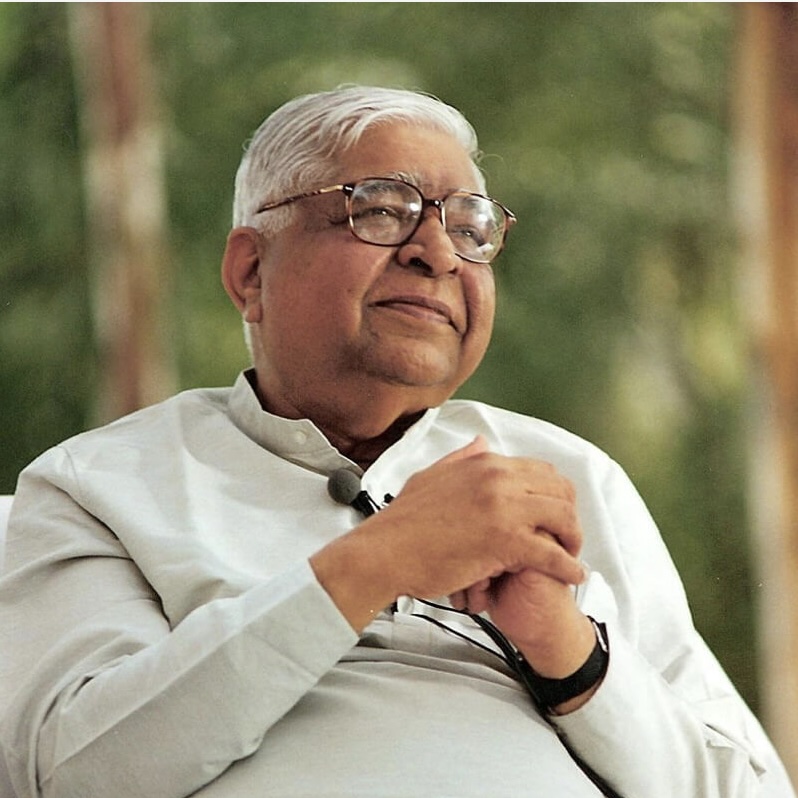
Although Indian by descent, Mr. Goenka was born and raised in Myanmar (Burma). While living there, he had the good fortune to come into contact with Sayagyi U Ba Khin and to learn the technique of Vipassana from him. After receiving training from his teacher for 14 years, Mr. Goenka settled in India and began teaching Vipassana in 1969. In a country still sharply divided by differences of caste and religion, the courses offered by Mr. Goenka soon attracted thousands of people from every part of society. In addition, many people from countries around the world came to join courses in Vipassana meditation.
Over a period of almost 45 years, Mr. Goenka and the teachers appointed by him taught hundreds of thousands of people in courses in India and other countries, East and West. Today, meditation centers established under his guidance are operating in Asia, Europe, the Americas, Africa and Australasia.
The technique taught by S.N. Goenka goes back two and a half millennia to the Buddha. The Buddha never taught a sectarian religion; he taught Dhamma – the way to liberation – which is universal. In the same tradition, Mr. Goenka’s approach is totally non-sectarian. For this reason, his teaching has had a profound appeal to people of all backgrounds, of every religion and no religion, and from every part of the world.
Mr. Goenka was the recipient of many awards and honors in his lifetime, including a prestigious Padma Awards from the President of India in 2012. This is one of the highest civilian awards given by the Indian Government.
Satya Narayan Goenka breathed his last in September 2013, at the age of 89. He has left behind an imperishable legacy: the technique of Vipassana, now available more widely than ever before to people around the world.
Satya Narayan Goenka was the foremost lay teacher of Vipassana meditation of our time.
To view S. N. Goenka’s United Nations address video, please click here.
Frequently Asked Questions
Why is the course ten days long?
Actually, the ten-day course is the minimum; it provides an essential introduction and foundation to the technique. To develop in the practice is a lifetime job. Experience over generations has shown that if Vipassana is taught in periods of less than ten days, the student does not get a sufficient experiential grasp of the technique. Traditionally, Vipassana was taught in retreats lasting seven weeks. With the dawning of the 20th century, the teachers of this tradition began to experiment with shorter times to suit the quickening pace of life. They tried thirty days, two weeks, ten days, down to seven days–and they found that less than ten days is not enough time for the mind to settle down and work deeply with the mind-body phenomenon.
How many hours a day will I be meditating?
The day begins at 4:00 a.m. with a wakeup bell and continues until 9:00 p.m. There are about ten hours of meditation throughout the day, interspersed with regular breaks and rest periods. Every evening at 7:00 p.m. there is a videotaped lecture by the Teacher, S.N. Goenka, which provides a context for meditators to understand their experience of the day. This schedule has proved workable and beneficial for hundreds of thousands of people for decades.
What language is used in the course?
The teaching is given through recordings of S.N. Goenka, speaking in English or Hindi, together with a translation into a local language. Tape translations exist in most of the major languages of the world, including English. If the teachers conducting a course do not speak the local language fluently, interpreters will be there to help. Language is usually no barrier for someone who wants to join a course.
How much does the course cost?
Each student who attends a Vipassana course is given this gift by a previous student. There is no charge for either the teaching, or for room and board. All Vipassana courses worldwide are run on a strictly voluntary donation basis. At the end of your course, if you have benefited from the experience, you are welcome to donate for the coming course, according to your volition and your means.
How much are teachers paid to conduct courses?
Teachers receive no payment, donations or other material benefit. They are required to have their own private means of support. This rule means that some of them may have less time for teaching, but it protects students from exploitation and it guards against commercialism. In this tradition, teachers give Vipassana purely as a service to others. All they get is the satisfaction of seeing people’s happiness at the end of ten days.
I can’t sit cross legged. Can I meditate?
Certainly. Chairs are provided for those unable to sit comfortably on the floor because of age or a physical problem.
I’m on a special diet. Can I bring my own food?
Students who come to courses can choose from the food provided in the center, and are asked to refrain from bringing food from home. Most people find the choice is ample and they enjoy the simple vegetarian diet. If your doctor has prescribed a special diet, let us know in advance and we will see whether we can provide what you need. If the diet is too specialized or might interfere with meditation, we might have to ask you to wait until you can be more flexible.
Can pregnant women attend courses? Are there any special arrangements or instructions for them?
Pregnant women may certainly attend, and many women come specifically during pregnancy to take advantage of the opportunity to work deeply and in silence during this special time. We ask pregnant women to ensure they are confident that their pregnancy is stable before applying. We provide the extra food they need and ask them to work in a relaxed way.
Why is a course conducted in silence?
All students attending the course observe “noble silence” — that is, silence of body, speech and mind. They agree to refrain from communicating with their co-meditators. However, students are free to contact the management about their material needs, and to speak with the instructor. Silence is observed for the first nine full days. On the tenth day, speech is resumed as a way of re-establishing the normal pattern of daily life. Continuity of practice is the secret of success in this course; silence is an essential component in maintaining this continuity.
Can I be confident that I am capable of doing the course?
Most participants successfully complete the course. You will need to be able to follow instructions and participate in a group setting for ten days. The course does require hard, serious work but if you are in reasonable physical and mental health and willing to make a sincere effort, the course will be manageable.
Do I have to stay for the entire course?
Yes. Note that the course spans 12 calendar days including the day you arrive and the day you leave.
Is there anyone who should not participate in a course because of a physical condition?
If you have questions about whether your physical condition or limitations would make it difficult to participate, please write to the email address in the Contact information for the Centre responsible for the course you are interested in.
I’m going through a difficult period in my life. Is it the right time for me to attend a course?
This depends upon what you are going through. After carefully reading the Introduction to the Technique and Code of Discipline, please consider if you feel ready to participate in such an intensive program at this time. If so, you are welcome to apply describing your circumstances and what you have been experiencing. We will then advise you further during the application process.
Is Vipassana intended to cure physical or mental illness?
No. Vipassana is not a cure for illness, but it can help to reduce the mental suffering that may accompany it. With the technique of Vipassana, meditators learn how to reduce negative habit patterns of the mind and cope better with their reactions to life events, including physical and mental difficulties and illness. Vipassana meditation is not a treatment or therapy; the teachers and volunteers are not medical, psychological, or counselling practitioners, nor caregivers.
How about depression, anxiety, panic or PTSD? Can Vipassana cure these?
If your experience of depression, anxiety, panic or PTSD is overwhelming, with a significant impact on your daily life, the best thing may be to work with a health professional. The purpose of Vipassana is not to cure illness but to reduce negative mental habit patterns.
Can Vipassana make people mentally unbalanced?
Although most people report improvements in their mental well-being after participating in a course, reaction patterns one may have experienced in the past could resurface. Previously unknown mental reaction patterns may also arise, potentially resulting in uncomfortable thoughts and sensations. Participants must be in good physical and mental health to be able to use the practice to work with these. It is important for you to let us know your mental health history when you apply for a course.
I have a history of significant mental health issues. Is this course likely to be suitable for me?
Even if your mental health is currently stable, with or without medication, old symptoms may resurface during or after the course. Psychological conditions that have been in remission may reoccur. If this were to happen during the course you may not be able to benefit from it. For this reason, in some cases we do not recommend a Vipassana course for people with a history of significant mental health conditions.
Do I have to be a Buddhist to practice Vipassana?
People from many religions and no religion have found the meditation course helpful and beneficial. Vipassana is an art of living, a way of life. While it is the essence of what the Buddha taught, it is not a religion; rather, it is the cultivation of human values leading to a life which is good for oneself and good for others.